Boost Your Rentals with SEO for Property Managers
Learn how SEO for Property Managers attracts qualified tenants, boosts visibility, and fills vacancies faster — without paid ads.
GET LEADSPROPERTY MANAGERSAPARTMENTSMULTI FAMILY HOUSINGSENIOR LIVING
Lauren Poling
10/29/20259 min read
Your occupancy reports are decent, but you know they could be better. You have great properties, but attracting a steady stream of qualified tenants feels like a constant struggle. A proper plan for SEO for Property Managers can change that, creating a system where potential clients find you effortlessly.
I’ve seen firsthand how a strong online presence helps property managers attract qualified tenants and fill vacancies faster. Search engine optimization is not a complicated technical puzzle reserved for experts. It is a direct method for filling your vacancies by connecting with the right people at the right time.
Forget the costly guesswork of paid Google Ads that drain your budget. A solid SEO strategy builds a real, lasting digital foundation. Follow these steps to increase visibility and win more qualified tenants.
Table Of Contents:
What is SEO and Why Should Property Managers Care?
The Foundation: A Winning Local SEO Strategy
Your Most Powerful Tool: Google Business Profile (GBP)
Optimizing Your Listings
The Power of Google Posts and Q&A
Managing Online Reviews
Content that Attracts Your Ideal Tenant
Property Pages that Convert
Neighborhood Guides That Build Authority
Technical SEO for Property Managers that Gets You Seen
Mobile-First is a Must
On-Page SEO Basics
Structured Data for Properties
How to Track Your SEO Success
Conclusion
What is SEO and Why Should Property Managers Care?
SEO stands for Search Engine Optimization. It is the process of improving your property management website so it is easy for search engines like Google to find and understand. When someone searches for “apartments in [your city],” you want your properties to appear at the top of the organic search results.
This matters because that is where your future tenants are looking for their next home. People rarely use print ads or drive around looking for signs anymore. They use their phones to search for exactly what they want, precisely when they need it.
If you are not visible in these searches, you are missing out on a huge number of potential leads. A good management SEO plan means more website traffic, more phone calls, and more tours scheduled. It all contributes to higher occupancy rates and a healthier bottom line for your business model.
The Foundation: A Winning Local SEO Strategy
For any property management company with physical locations, local SEO is the cornerstone of its digital marketing efforts. Your potential tenants are searching for properties in their immediate area, so your online presence needs to dominate local searches. Appearing in the Google local pack (the map and three listings at the top of the search results) can dramatically increase leads.


It starts with your key business information. Your property’s name, address, and phone number (NAP) must be identical everywhere it appears online. This consistency builds trust with search engines and is one of the most basic ranking factors for local search.
From my experience working with property managers who use dynamic number insertion (DNI) for call tracking, one key step often gets overlooked: maintaining a consistent “canonical” number across all citations. When you use rotating or tracking numbers, your website’s HTML should still include the primary business number that matches what appears in directories and listings. This ensures Google indexes and associates the correct number with your brand identity.
In your Google Business Profile, you can safely use the tracking number as the primary phone number for analytics purposes and add your canonical number as the additional phone number. This allows you to keep NAP consistency intact while still tracking leads effectively — the best of both worlds. (Sources: SEO Design Chicago, 800.com, RicketyRoo)
For property management companies overseeing multiple communities, this step is essential. Each property should have its own dedicated page on your website with unique content. This page functions as a local hub with specific details for that community, helping you rank for searches specific to each neighborhood and giving you a competitive advantage.
Your Most Powerful Tool: Google Business Profile (GBP)
If you focus on one area, it should be your Google Business Profile. This free business listing is often the first impression a potential tenant has of your property. For property managers, a well-maintained business profile is absolutely essential for attracting the modern local consumer.
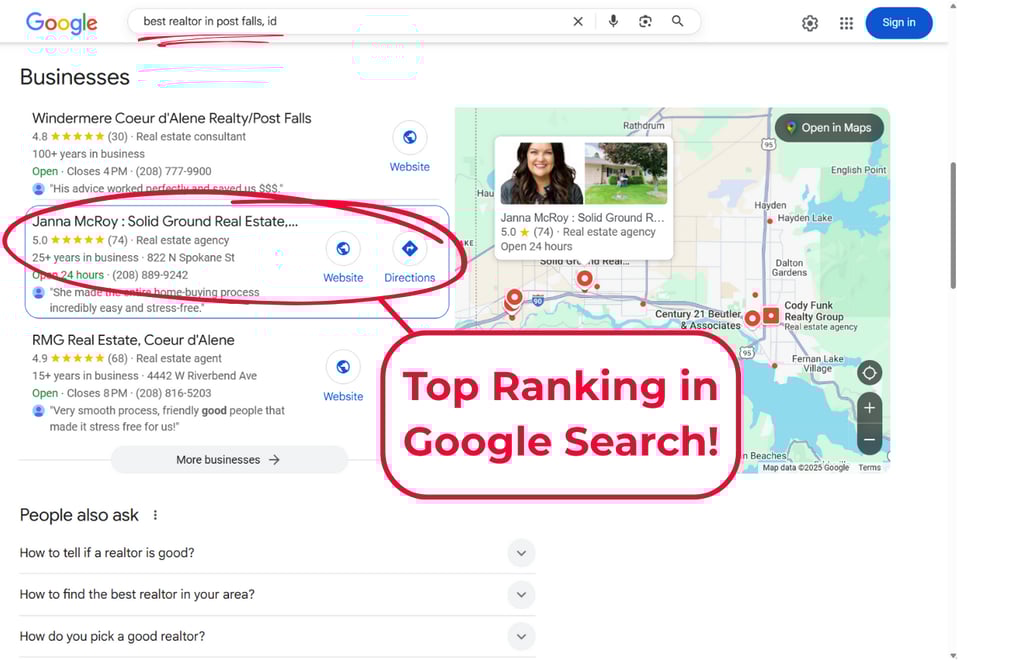
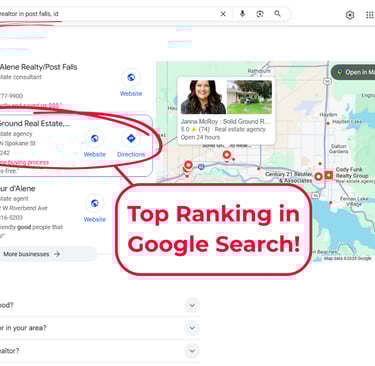
Your Google Business Profile is where your address, hours, photos, and reviews are all displayed in one convenient location in Google Search and Maps. Through my work with real estate professionals, I’ve seen firsthand how optimizing a Google Business Profile can completely transform visibility and lead flow. For example, after implementing SEO and GBP strategies for Janna McRoy, a top North Idaho Realtor now ranking #2 in Google search results for ‘best realtor in Post Falls, ID,’ we proved how powerful a well-maintained profile can be.
Optimizing Your Listings
You need to claim and verify a separate GBP listing for each property you manage. Do not just set it up and forget about it; these profiles require ongoing attention. Diligently fill out every available section of the profile to give Google as much information as possible.
Choose accurate categories for your business. The primary category should be specific, like “Apartment Building” or “Property Management Company,” followed by relevant additional categories. Use high-quality, professional photos of your units, grounds, amenities, and common areas, as visual appeal greatly impacts user experience.
From my experience managing GBP optimization for multiple property-based businesses, geotagging images before uploading them makes a measurable difference in local visibility. When your photo’s metadata includes the property’s latitude and longitude, Google associates that image with your specific location — reinforcing your local relevance signals. It takes less than a minute per photo and can be done using free tools like GeoImgr. Over time, this small detail helps improve how often your listings appear in nearby searches.
Virtual tour videos are also incredibly effective and should be added if you have them. Double-check that every detail is correct. Nothing frustrates a prospective renter more than showing up to a closed leasing office because the hours were wrong on a business listing.
The Power of Google Posts and Q&A
Google Posts are like mini blog updates that appear directly on your Google Business Profile. You can use them to announce move-in specials, highlight a newly renovated unit, or promote a community event. I even use them to promote new blogs on my website. It’s time to use this feature to show potential tenants that your property is active and professionally managed.
Also, pay close attention to the Questions & Answers section of your profile. People will ask important questions like “What is your pet policy?” or “Is parking included in the rent?” Answering these questions publicly helps everyone and demonstrates that you provide excellent customer service.
You can even proactively add your own frequently asked questions and answer them. This lets you control the narrative and address common concerns before they become a barrier for potential clients. This simple SEO tactic pays long-term dividends.
Managing Online Reviews
Online reviews are powerful social proof that can heavily influence a person’s decision to schedule a tour. Good reputation management starts with actively encouraging happy residents to leave a review. More importantly, you must respond to every single review, including both the positive and the negative ones.
A thoughtful, professional response to a negative review can actually win you business. It shows that you care about your residents’ experience and are committed to resolving problems. For prospective renters, and even property owners looking for a management company, this demonstrates that you value your community.
Positive reviews provide valuable feedback and boost your SEO ranking. Google sees a steady stream of good reviews as a signal of a quality local business. It’s easy to ask for reviews, so make it part of your process.
Content that Attracts Your Ideal Tenant
Your property management website is your digital leasing office. It needs to provide potential renters with all the information they need to get excited about your properties. This is where a strategic content marketing plan becomes essential.
Your objective is to answer every question a renter might have before they even think to ask it. This approach builds trust and positions your management company as the best option in the local market. Let’s look at how to create content that converts visitors into leads.
Property Pages that Convert
Each property needs a detailed page that functions as a comprehensive digital brochure. This is not the place for vague, generic descriptions. Get specific with your details to attract qualified renters.
Include clear, easy-to-read floor plans for every unit type available. List every single amenity, from the in-unit washer and dryer to the community fitness center and pet-friendly policies. Create beautiful photo galleries and, if possible, embed high-quality video tours for a more immersive experience.
Finally, make it incredibly simple for visitors to take the next step. Your “Schedule a Tour” or “Apply Now” calls-to-action should be prominent and easy to find on the page. Do not make prospective renters hunt for a way to contact you.
Neighborhood Guides That Build Authority
Neighborhood content does more than showcase a property — it positions your company as a trusted local expert. Renters want to understand what life looks like beyond the apartment walls, from nearby amenities to the community vibe. Creating content that highlights the lifestyle surrounding your properties helps you attract renters who are still deciding where they want to live — and gives your business a powerful edge in local search results.
Write about the best local parks, coffee shops, and restaurants near your properties. Develop a guide to the local school district or highlight public transportation options. This content is extremely valuable to searchers and shows that you are a true local expert, which boosts backlinks and strengthens your website authority.
By using a long-tail keyword strategy focused on neighborhood-specific terms, you can capture a wider audience. This helps build your marketing brand and establishes you as a go-to resource in the real estate space. Such a content strategy based on local expertise can significantly improve organic rankings.
Technical SEO for Property Managers that Gets You Seen
You can have the most beautiful management website in the world, but if search engines cannot properly crawl and understand it, you will not get any traffic. Technical search engine optimization is the behind-the-scenes work that makes your site friendly to search engines. You do not need to be a coding expert, but getting the basics right is crucial for online visibility.
Mobile-First is a Must
The vast majority of your prospective tenants are searching for their next home on a smartphone. Your website must look great and function perfectly on a small screen. If your site is slow to load or difficult to navigate on a phone, they will leave and never come back.
Google also prioritizes mobile-friendly websites in its search rankings. Having a site that works well on phones is not just for user convenience; it’s a direct signal that helps your property management SEO. Test your site on your own phone to see how the experience feels for a local consumer.
On-Page SEO Basics
On-page SEO involves optimizing individual web pages to rank higher and earn more relevant traffic. Every page on your website, especially your property pages, should have a unique title tag that includes the property name and location. A compelling meta description should also be written for each page, acting as a mini-advertisement in the search results to encourage clicks.
Use header tags (H1, H2, H3) to structure your content and make it easy for both users and search engines to read. Your main page title should be an H1, with subheadings as H2s and H3s. Internal linking, or linking from one page on your site to another, helps Google understand the structure of your website and spreads authority between your pages.
Structured Data for Properties
This may sound complex, but the concept is straightforward. Structured data, also known as schema markup, is a specific type of code you add to your website. This code helps search engines understand the context of your content more deeply.
For example, you can use schema to tell Google that a number is a monthly rent price, a block of text is a list of amenities, and another detail is the number of bedrooms. According to Google’s SEO guidelines, adding structured data helps your properties appear with richer details in search results. Following Google’s guidelines for structured data is also what helps your content get pulled into AI-generated content and search results, which is becoming increasingly important.
How to Track Your SEO Success
One of the best parts of a search marketing plan is that you can track everything. You do not have to guess if your efforts are working. The goal is to eliminate guesswork and see exactly what activities are driving real results for your management company.
You should monitor a few key metrics regularly using a free tool like Google Analytics. The first is organic traffic. Are more people finding your property management website through organic search this month compared to last month?
Next, use a tool like Google Search Console to check your keyword rankings and see what queries people use to find you. Are you showing up higher for valuable terms like “[your city] apartments for rent”? Finally, look at your Google Business Profile insights to see how many people called you, visited your website, or asked for directions directly from your listing. These are the numbers that show real business growth from your SEO strategy efforts.
Conclusion
Building a steady pipeline of qualified leads does not happen by accident. It is the result of a consistent and thoughtful strategy for property management SEO. By focusing on your local presence, optimizing your Google Business Profiles, and creating helpful, targeted content, you can attract the right tenants directly to your website.
Prioritize clarity and usefulness—give renters the information they need where they are already searching for it. When done correctly, your marketing plan will deliver more applications, fewer vacancies, and a stronger, more stable business.
Ready to strengthen your online presence? Realty Streamliners specializes in SEO for Property Managers — from Google Business optimization to content strategy that drives real leads. Contact us today to get started.
Note: Results may vary based on competition, location, and implementation consistency.